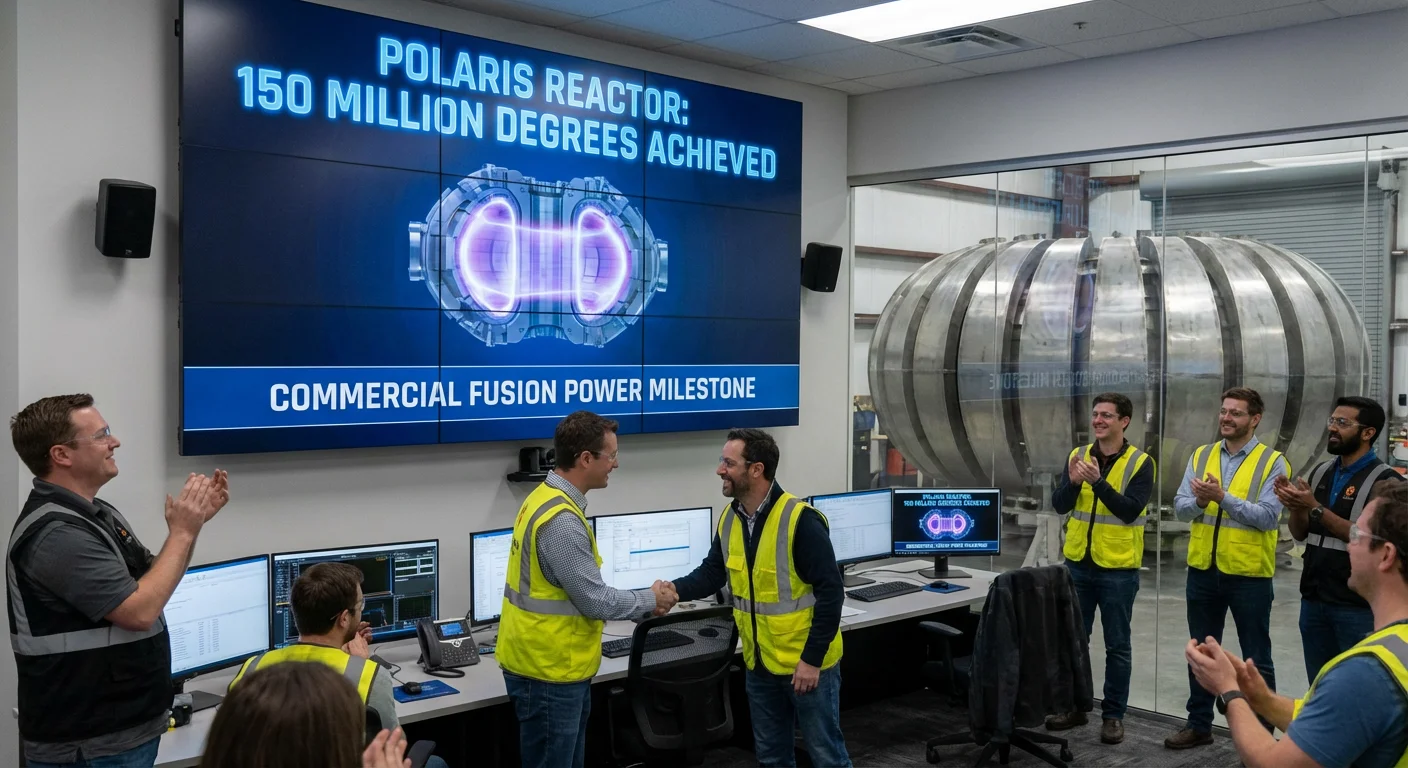
The quest for commercial fusion energy has reached a transformative milestone as Helion Energy’s Polaris reactor achieved plasma temperatures exceeding 150 million degrees Celsius—ten times hotter than the sun’s core. This breakthrough represents the highest temperature ever recorded in a field-reversed configuration reactor, positioning Helion at the forefront of fusion power commercialization. Unlike traditional experimental reactors that remain decades from practical deployment, Helion’s technology targets electricity delivery to customers by 2028 through a groundbreaking contract with Microsoft.
Fusion energy promises unlimited clean power by replicating the nuclear reactions that fuel stars, but achieving the extreme conditions necessary for sustained energy production has eluded researchers for seventy years. Helion’s approach differs fundamentally from conventional magnetic confinement fusion designs like tokamaks. The company employs a pulsed system using field-reversed configuration that compresses deuterium-helium-3 fuel to fusion conditions, then directly converts the reaction energy into electricity without steam turbines or traditional power generation infrastructure.
This direct electricity generation fusion method achieves dramatically higher efficiency than competing approaches. While tokamak designs like those pursued by Commonwealth Fusion Systems require complex breeding blankets to produce tritium fuel and massive superconducting magnets, Helion’s streamlined architecture produces its own helium-3 fuel from deuterium-deuterium reactions. The result is a compact, scalable fusion reactor design that addresses both technical feasibility and economic viability—the twin challenges that have prevented fusion from becoming practical energy infrastructure.
What is Helion Fusion Energy?
Helion Energy is a private fusion startup founded in 2013 that has developed a unique approach to achieving commercial fusion power through field-reversed configuration technology. Based in Everett, Washington, the company has raised over $575 million in venture capital from investors including Sam Altman, Peter Thiel, and Capricorn Investment Group. Unlike government-funded research programs focused on scientific demonstration, Helion operates with clear commercialization timelines and binding electricity delivery contracts.
The company’s technology represents a departure from seventy years of fusion research dominated by tokamak designs. Rather than attempting to sustain continuous plasma confinement in donut-shaped magnetic chambers, Helion creates discrete fusion pulses by accelerating and compressing plasma rings. This pulsed approach solves fundamental engineering challenges associated with continuous operation, including material degradation from constant neutron bombardment and heat management in reactor walls.
Helion’s business model centers on selling electricity directly to enterprise customers rather than licensing reactor technology or pursuing government research contracts. The Microsoft fusion electricity contract signed in 2023 commits Helion to deliver 50 megawatts of fusion-generated power by 2028, with financial penalties if the company fails to meet performance targets. This unprecedented commercial agreement demonstrates investor confidence in Helion’s technical approach and accelerated development timeline.
The company has constructed seven progressively larger prototype reactors, with Polaris representing the latest iteration designed to demonstrate net energy production. Each generation incorporated lessons from previous experiments, systematically addressing plasma temperature, confinement time, and energy conversion efficiency. This iterative development strategy contrasts sharply with massive one-time construction projects like ITER that require decades between concept and operation.
How Field-Reversed Configuration Reactors Work
Field-reversed configuration technology creates self-contained plasma structures that trap fusion fuel through their own magnetic fields rather than requiring external superconducting magnets. The process begins by ionizing deuterium gas into plasma using radio frequency heating, then shaping the plasma into compact rings using magnetic coils. These rings contain all the magnetic field lines needed for confinement within their own structure, making them stable and transportable.
Helion’s reactor features an hourglass-shaped chamber where plasma rings accelerate from opposite ends toward a central collision zone. Magnetic compression magnets along the chamber walls progressively squeeze the rings as they travel, heating the plasma through compression work similar to how diesel engines ignite fuel through pressure alone. When the rings collide and merge at the chamber center, their combined kinetic energy converts to thermal energy, driving temperatures above 150 million degrees Celsius.
At these extreme temperatures, deuterium nuclei overcome electrostatic repulsion and fuse, releasing enormous energy primarily as fast-moving charged particles. In traditional fusion designs using deuterium-tritium fuel mixtures, 80% of fusion energy emerges as neutrons that must be captured through thick breeding blankets and converted to heat for steam generation. Helion’s deuterium-helium-3 fusion produces charged particles instead, enabling direct electricity generation through inductive energy harvesting.
The plasma expansion following each fusion pulse drives current through coils surrounding the reactor chamber, directly generating electricity without thermal conversion losses. This direct energy conversion achieves theoretical efficiency above 70%, compared to 40% maximum efficiency for conventional thermal power plants. The pulsed operation cycle repeats approximately once per second, creating steady electricity output from discrete fusion events rather than continuous reaction.
Deuterium-Helium-3 Fusion Advantages
Helion’s fuel choice represents a strategic departure from mainstream fusion research that overwhelmingly focuses on deuterium-tritium reactions. Tritium, a radioactive hydrogen isotope with a 12-year half-life, does not exist naturally and must be bred from lithium using neutrons generated by fusion reactions. This creates circular dependency where reactors must produce their own fuel while managing radioactive inventory and neutron-damaged reactor components.
Deuterium-helium-3 fusion produces minimal neutron radiation because the primary reaction yields protons and helium-4, both charged particles that respond to magnetic confinement. This aneutronic characteristic eliminates breeding blanket requirements, dramatically reduces radioactive waste generation, and extends reactor component lifetimes by preventing neutron embrittlement. The result is simpler reactor design with lower maintenance costs and enhanced safety characteristics.
Helium-3 scarcity presents the primary challenge for this fuel cycle, as the isotope exists in only trace quantities on Earth. Helion addresses this through a two-stage fusion process where initial deuterium-deuterium reactions produce both energy and helium-3 as a byproduct. The reactor recycles this generated helium-3 back into the fusion chamber for subsequent deuterium-helium-3 reactions, creating a closed fuel cycle that produces its own rare isotope rather than requiring external supplies.
The fusion fuel cycle refinement occurs through magnetic separation of reaction products. After each pulse, the plasma contains unreacted deuterium, newly created helium-3, and fusion ash comprising helium-4 and trace tritium. Magnetic fields sort these species by mass and charge, directing helium-3 into storage for reinjection while exhausting helium-4. This continuous fuel processing enables sustained operation without external helium-3 sourcing.
Polaris Reactor Technical Achievements
The Polaris reactor represents Helion’s seventh-generation prototype and first system designed to achieve fusion breakeven—the point where energy output exceeds input required to heat and confine plasma. Construction completed in 2023 at Helion’s Everett facility, with the reactor occupying approximately 2,000 square feet including power supplies, vacuum systems, and diagnostic equipment. The relatively compact footprint demonstrates field-reversed configuration scalability advantages over building-sized tokamak installations.
Achieving 150 million degrees Celsius plasma temperature required systematic optimization of magnetic compression timing, plasma density, and heating power delivery. Previous prototypes reached progressively higher temperatures, with the sixth-generation Trenta reactor achieving 100 million degrees in 2021. The Polaris temperature milestone surpasses minimum requirements for efficient deuterium-helium-3 fusion, which becomes favorable above 120 million degrees Celsius.
Plasma confinement time in field-reversed configurations historically limited energy output, as plasma rings dissipate before sufficient fusion reactions occur. Polaris incorporates advanced magnetic field shaping that extends confinement duration while maintaining compression efficiency. Diagnostic measurements show plasma stability sufficient to generate meaningful fusion reactions, though Helion has not publicly disclosed specific confinement time values or fusion yield data.
The reactor’s direct electricity generation circuits demonstrated successful energy recovery from plasma expansion, validating the core technical premise enabling high-efficiency fusion power. During experimental pulses, expanding plasma drives current through inductive coils, generating electrical power that feeds back into reactor systems. This proof-of-concept for fusion electricity efficiency positions Polaris as the foundation for Helion’s next-generation commercial reactor.
Helion vs Traditional Fusion Approaches
| Feature | Helion Field-Reversed | Tokamak (ITER, Commonwealth) | Inertial Confinement (NIF) |
|---|---|---|---|
| Fuel Type | Deuterium-Helium-3 | Deuterium-Tritium | Deuterium-Tritium |
| Operation Mode | Pulsed (1 Hz) | Continuous | Pulsed (microseconds) |
| Confinement Method | Magnetic self-confinement | External superconducting magnets | Laser compression |
| Neutron Production | Minimal (aneutronic) | High (80% energy as neutrons) | High |
| Energy Conversion | Direct electrical | Thermal (steam turbine) | Thermal (steam turbine) |
| Reactor Size | Compact (room-scale) | Massive (building-scale) | Large facility |
| Commercialization Target | 2028 | 2040s-2050s | Research only |
Tokamak reactors like ITER and Commonwealth Fusion Systems designs pursue continuous plasma confinement in toroidal magnetic bottles maintained by superconducting coils. This approach has achieved the longest confinement times and highest fusion yields in experimental settings but requires extremely complex engineering to manage plasma stability, heat extraction, and neutron shielding. The massive scale and superconducting magnet costs present significant commercialization barriers.
Inertial confinement fusion, exemplified by the National Ignition Facility’s 2022 breakthrough, uses powerful lasers to compress fusion fuel capsules to extreme densities for microsecond durations. While NIF achieved fusion energy gain, the approach requires precision manufacturing of millions of fuel capsules annually and massive laser systems unsuitable for practical power generation. Research focuses on scientific understanding rather than commercial deployment.
Helion’s pulsed magnetic confinement occupies a middle ground, achieving sufficient plasma parameters through compression rather than continuous confinement or extreme compression. The field-reversed configuration avoids superconducting magnet costs while the deuterium-helium-3 fuel eliminates breeding blanket complexity. This combination targets the optimal balance between technical feasibility and economic viability for near-term commercialization.
Microsoft Fusion Partnership and 2028 Timeline
Microsoft’s 2023 power purchase agreement with Helion represents the first commercial fusion electricity contract in history, committing the tech giant to purchase 50 megawatts of fusion-generated power starting in 2028. The agreement includes financial penalties for delivery delays and performance guarantees ensuring reliable electricity supply, demonstrating unprecedented confidence in fusion commercialization timelines. Microsoft’s motivation centers on achieving carbon-neutral data center operations without relying solely on intermittent renewable sources.
The 50-megawatt capacity targets a single hyperscale data center’s baseload power requirements, providing continuous electricity without battery storage or backup generation. Unlike solar and wind installations requiring extensive land area and facing weather-dependent output variation, Helion’s compact fusion reactors deliver constant power from small footprints. This aligns with enterprise sustainability goals while addressing practical grid connection and real estate constraints.
Helion must construct its first commercial-scale reactor to fulfill the Microsoft contract, scaling from Polaris’s experimental configuration to a system generating net electrical output. The company projects this eighth-generation reactor, tentatively named after celestial bodies following the naming pattern, will demonstrate sustained fusion electricity pulse harvesting at megawatt-class output levels. Engineering challenges include increasing pulse repetition rate, improving energy recovery efficiency, and ensuring reliable year-round operation.
The 2028 commercialization timeline compresses typical fusion development schedules by decades, raising questions about technical risk and regulatory approval timelines. Helion benefits from operating outside traditional nuclear licensing frameworks because deuterium-helium-3 fusion produces minimal radioactive waste and lacks fission materials. However, the company must still satisfy safety regulators and demonstrate reliable operation before connecting to electrical grids serving critical infrastructure.
Fusion Energy Venture Capital and Investment Landscape
Private fusion startups have attracted over $6 billion in venture capital investment since 2021, reflecting growing investor confidence in commercialization prospects. Helion leads this funding wave with its $575 million total raised, but Commonwealth Fusion Systems has secured over $2 billion for tokamak-based technology, while TAE Technologies and other competitors pursue alternative confinement schemes. This capital influx contrasts sharply with government fusion programs that face budget constraints and political uncertainty.
Series A funding for fusion startups typically occurs after demonstrating basic plasma confinement and achieving key technical milestones like minimum temperature thresholds. Subsequent rounds finance prototype construction, with valuations reaching billions of dollars for companies approaching net energy demonstration. Helion’s post-money valuation exceeds $3 billion following its latest funding round, positioning it among the most valuable private energy technology companies globally.
Investor profiles span traditional venture capital, energy-focused funds, and technology billionaires with long-term perspectives. Sam Altman, CEO of OpenAI, personally invested $375 million in Helion and serves as chairman, providing both capital and strategic guidance. This combination of patient capital and technical expertise enables development timelines incompatible with public market quarterly earnings pressure or government budget cycles.
The fusion energy infrastructure investment thesis centers on capturing portions of the multi-trillion-dollar global electricity market through superior economics compared to fossil fuels and intermittent renewables. Fusion reactors promise fuel costs near zero—deuterium extracts from seawater abundantly—with capacity factors exceeding 90% and minimal land requirements. If technical challenges resolve, fusion could displace coal, natural gas, and nuclear fission for baseload generation within decades.
Plasma Temperature Optimization and Energy Conversion
Achieving 150 million degrees Celsius required precise coordination of heating power delivery, magnetic compression timing, and plasma density control. Helion’s approach uses radio frequency heating to create initial plasma at moderate temperatures, then relies primarily on compression work to reach fusion-relevant conditions. This strategy minimizes external heating power requirements, improving overall energy efficiency and reducing reactor complexity compared to systems requiring continuous high-power heating.
Magnetic compression occurs through precisely timed current pulses in coils surrounding the hourglass chamber. As plasma rings accelerate toward center, progressively stronger magnetic fields squeeze them adiabatically—compression increases pressure and temperature without heat exchange to surroundings. This process converts magnetic field energy directly into plasma thermal energy with high efficiency, similar to principles governing gas compression in mechanical systems.
Plasma density optimization balances competing requirements for fusion reaction rate and energy confinement. Higher density increases collision frequency between fusion fuel nuclei, boosting reaction probability, but excessive density causes rapid energy loss through radiation and plasma instabilities. Polaris achieved optimal density profiles through careful fuel injection timing and magnetic field shaping that concentrates plasma in regions of strongest confinement.
Direct energy harvesting from plasma expansion reverses the compression process, converting fusion-heated plasma’s thermal energy into electrical current as magnetic fields decrease. The expanding plasma pushes against magnetic field lines, inducing current in surrounding coils through electromagnetic induction. High-efficiency plasma generation circuits capture this energy with minimal losses, achieving theoretical conversion efficiency above 70% compared to 30-40% typical for thermal power cycles.
Fusion Reactor Scalability and Commercial Deployment
Helion’s reactor design prioritizes modular scalability, with commercial units sized to match specific customer power requirements rather than following one-size-fits-all gigawatt-scale plants. The 50-megawatt Microsoft installation represents a single reactor module, but the company envisions arrays of multiple reactors providing hundreds of megawatts for industrial facilities or utility-scale generation. This modularity enables incremental capacity addition and reduces construction financing requirements compared to massive single-unit projects.
Manufacturing scalability leverages existing industrial capabilities rather than requiring specialized production facilities. Field-reversed configuration reactors use standard electromagnetic components, vacuum systems, and power electronics already manufactured at scale for particle accelerators, research facilities, and industrial processes. This supply chain accessibility contrasts with superconducting tokamaks requiring custom niobium-tin conductors and precision-machined vacuum vessels.
Site flexibility emerges from compact reactor footprints and minimal cooling water requirements. Unlike fission reactors demanding proximity to large water bodies for cooling or solar farms requiring extensive land areas, fusion reactors could deploy at urban data centers, industrial parks, or isolated facilities. This geographical flexibility eliminates transmission losses associated with remote power generation and improves grid resilience through distributed generation.
Regulatory pathways for fusion differ fundamentally from fission nuclear power, as fusion reactions cannot sustain chain reactions and produce minimal long-lived radioactive waste. Helion anticipates licensing under industrial facility regulations rather than Nuclear Regulatory Commission oversight, significantly accelerating approval timelines. However, precedent-setting regulatory frameworks remain under development as fusion approaches commercial readiness.
Conclusion
Helion Energy’s achievement of 150 million degree plasma in the Polaris reactor marks a decisive step toward commercial fusion power, transforming seven decades of research aspirations into near-term reality. The field-reversed configuration approach combined with deuterium-helium-3 fuel and direct electricity generation creates a technically feasible and economically viable pathway to clean, abundant energy. With Microsoft’s binding 2028 power delivery contract and over half a billion dollars in venture backing, fusion energy transitions from scientific curiosity to practical infrastructure. The fusion power plant timeline accelerates as private innovation overcomes barriers that stalled government programs, positioning fusion to address climate change and energy security simultaneously.