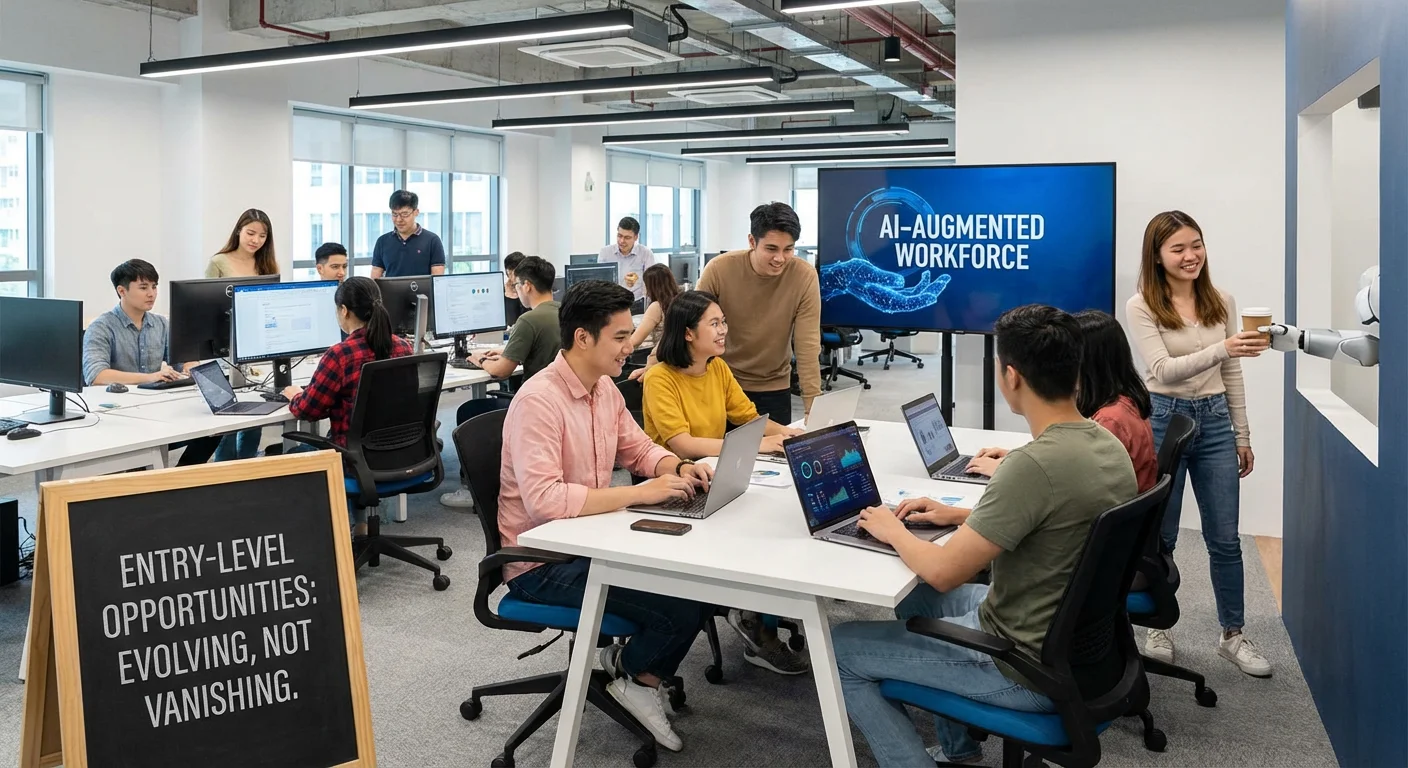
Amid widespread concern about AI replacing workers, a surprising trend has emerged: entry-level jobs aren’t disappearing. While AI tools are transforming how work gets done, data suggests the junior job market remains robust — it’s just evolving.
The Surprising Employment Data
Recent employment statistics challenge the AI displacement narrative:
- Entry-level hiring remains steady across most sectors
- Some industries actually show increased junior-level positions
- Job postings for entry-level roles continue growing
- Graduate employment rates holding stable despite AI advancement
Why AI Isn’t Eliminating Entry-Level Jobs
Several factors protect entry-level positions from AI disruption:
Human Judgment Remains Essential: Entry-level roles often require contextual understanding, interpersonal skills, and judgment that AI cannot replicate.
Training Ground Function: Companies still need entry-level positions to develop future managers and leaders who understand the business from the ground up.
Complex Task Components: Most entry-level jobs involve diverse tasks where AI can assist with some components but cannot handle the full scope.
Cost Considerations: Hiring entry-level employees often remains more cost-effective than implementing comprehensive AI solutions.
How AI Is Reshaping Entry-Level Work
Rather than eliminating jobs, AI tools are changing what entry-level workers do:
Automation of Routine Tasks: AI handles repetitive data entry, basic analysis, and administrative tasks, freeing junior employees for higher-value work.
Enhanced Productivity: Entry-level workers using AI tools accomplish more in less time, increasing their value to employers.
Skill Evolution: New entry-level positions require AI literacy alongside traditional skills.
Changed Job Descriptions: Roles increasingly emphasize creativity, communication, and problem-solving over rote task execution.
New Opportunities Created by AI
AI development actually creates entry-level opportunities:
- AI training and data labeling positions
- Junior AI ethics researchers
- Entry-level prompt engineers
- AI content reviewers and moderators
- Junior positions in AI implementation teams
What Entry-Level Workers Should Focus On
To thrive in the AI era, young professionals should develop:
AI Literacy: Understanding how to work alongside AI tools effectively.
Critical Thinking: Skills that complement rather than compete with AI capabilities.
Communication: Human interaction abilities that AI cannot replicate.
Adaptability: Willingness to learn new tools and approaches continuously.
Domain Expertise: Deep knowledge in specific areas where human understanding adds value.
Industry-Specific Insights
Different sectors show varied AI impact on entry-level roles:
Technology: Increased entry-level positions in AI development, testing, and implementation.
Finance: AI handles routine analysis, but entry-level analysts focus on interpretation and client relationships.
Marketing: Junior marketers use AI tools for content and data analysis while focusing on strategy and creativity.
Healthcare: Entry-level positions shift toward patient interaction while AI handles administrative tasks.
Legal: Junior associates use AI for research but remain essential for client communication and nuanced analysis.
The Skills Gap Reality
Interestingly, many industries face entry-level talent shortages despite AI advancement:
- Demand for AI-literate workers exceeds supply
- Traditional entry-level skills remain in high demand
- Companies struggle to find candidates with both technical and soft skills
- Training programs can’t keep pace with industry needs
Expert Perspectives
Labor economists studying AI’s impact note:
“AI is a tool, not a replacement for human workers. Entry-level positions evolve to leverage AI rather than being eliminated by it. The jobs that disappear are often ones we’re happy to see automated.”
AI Ethics Considerations
The entry-level employment question raises important ethical issues:
- Ensuring equitable access to AI skills training
- Preventing AI from exacerbating employment inequality
- Maintaining pathways for career advancement
- Protecting workers during transition periods
What Employers Are Saying
Companies implementing AI tools consistently report:
- Need for human workers to manage AI outputs
- Importance of entry-level employees in customer-facing roles
- Value of junior staff in identifying AI limitations
- Continued investment in entry-level hiring and training
Preparing for the Future
Rather than fearing AI displacement, entry-level job seekers should:
- Embrace AI tools as productivity enhancers
- Develop skills that complement AI capabilities
- Seek employers investing in employee development
- Stay curious and adaptable to technological change
The Bottom Line
AI news often emphasizes job displacement, but the reality for entry-level positions is more nuanced. Jobs aren’t disappearing — they’re transforming. Young professionals who combine traditional skills with AI literacy will find themselves more valuable, not less, in the evolving job market.
The future of entry-level work involves humans and AI working together, each doing what they do best. That’s not a future to fear — it’s an opportunity to embrace.