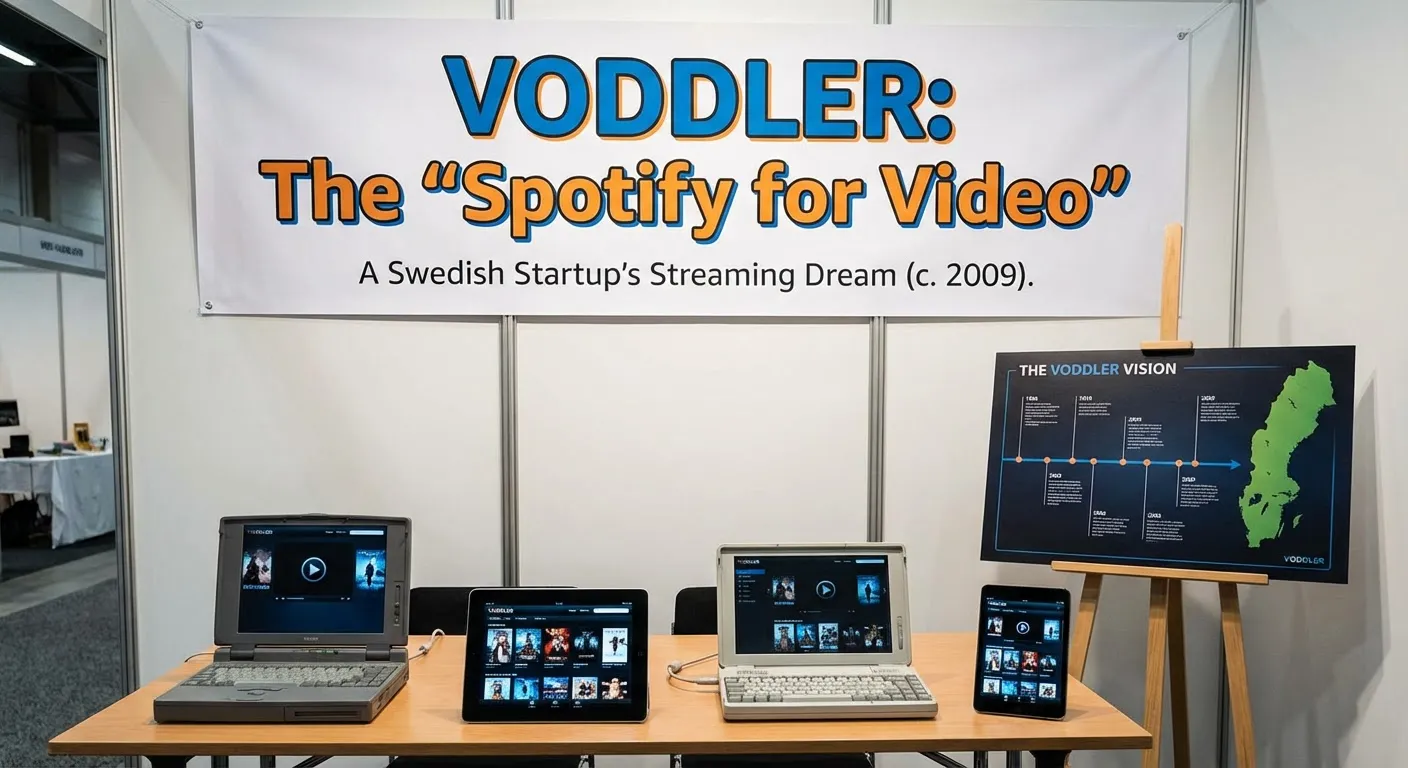
Origins: A Stockholm Vision for Online Video
Long before streaming became a household word, a small team in Stockholm was working on something ambitious. Voddler was founded in 2005 by Martin Alsen, Magnus Dalhamn, and Mattias Bergström — a Swedish startup with the audacious goal of making movies and TV shows legally available online, at a time when digital distribution was still in its infancy and piracy was rampant.
The company was reorganized in 2008 when investors Marcus Starberger and Mathias Hjelmstedt stepped in, bringing fresh capital and industry expertise. Starberger, who had deep roots in the film industry — particularly in distribution across cinemas, video stores, and broadcast television — was given a mandate to build a proper end-to-end distribution system for films and TV series via the web. What followed was a years-long experiment that placed Voddler at the frontier of the streaming revolution in Europe.
The Technology: Peer-to-Peer at Its Core
What distinguished Voddler from competitors wasn’t just its catalog or its business model — it was the underlying technology. Voddler developed a proprietary peer-to-peer streaming system it called VNet (later branded VoddlerNet).
Rather than streaming video from a central server or a traditional content delivery network (CDN), VNet distributed delivery across its own users. When someone watched a film, fragments of that video would temporarily remain on their device. The next viewer to request the same title would receive parts of it from those distributed nodes — other users’ machines — rather than from a single server. The more popular a title, the more nodes held pieces of it, making delivery faster and more resilient. Less popular content would naturally cycle off the network.
The practical advantages were significant. For Voddler, peer-to-peer delivery dramatically reduced infrastructure costs, since bandwidth was effectively crowd-sourced. For viewers, it meant smoother, more reliable playback — the network grew stronger with every additional user rather than weaker.
Voddler eventually filed some 18 patents related to its VNet streaming technology, a reflection of how seriously the company took its technical edge.
Content Deals and the Path to 1.2 Million Users
Building a streaming service requires two things: technology and content. On the content side, Voddler worked hard to secure licensing agreements with major Hollywood studios, including Warner Bros., Paramount, Sony Pictures, Disney, DreamWorks, NBC Universal, MGM, Miramax, and BBC Worldwide. This was no small feat for a small Nordic startup, and it gave Voddler a catalog of thousands of titles — including both American blockbusters and Scandinavian films.
Voddler launched its service to Scandinavian users around 2010. Its early media player featured a 10-foot interface designed for living-room television viewing, though the company updated it in March 2010 to support mouse and keyboard controls for desktop users.
By 2012, Voddler had expanded to Spain, and by 2013, the platform had accumulated over 1.2 million registered users across Scandinavia and Spain — a meaningful milestone that validated the core proposition.
Innovation: LiveShelf and ViewShare
In April 2013, Voddler unveiled what it called the next phase of its platform: LiveShelf and ViewShare.
LiveShelf was an online video shelf — a personal library where users could rent titles (typically around $5), purchase them permanently (around $10), or access free titles from the catalog. The service was designed to be device-agnostic, working across mobile phones, tablets, PCs, and televisions.
ViewShare was the more radical innovation. Described by the company as the world’s first legal film-sharing service, ViewShare allowed Voddler users to invite friends to watch films from their personal library — essentially digitizing the age-old habit of lending movies to one another. CEO Marcus Bäcklund framed it simply: the service embraced the fact that people had always lent movies to each other, and ViewShare let them continue doing so online, legally. Free users could share with up to ten others; subscribers paying a monthly fee for “Voddler Plus” could share with an unlimited number of viewers.
This freemium approach — combining free access with premium sharing — placed Voddler squarely in the same category as Spotify, which had popularized the model in music. The comparison was so apt that Voddler became routinely described in the press as “Spotify for video.”
Going Global
April 2013 was also when Voddler announced its global expansion. Having spent years proving the concept in Scandinavia and Spain, the company activated LiveShelf across Europe and Russia within days, with North and South America, Asia, and the rest of the world to follow in the coming weeks.
The expansion was made possible in part by Voddler’s technology. Unlike server-based streaming services that required expensive infrastructure buildouts in every new market, VoddlerNet’s distributed architecture scaled naturally — adding a new market meant connecting new users to the existing network, not building new server farms.
By this point, Voddler had raised approximately €24 million (around $31 million) in venture capital, backed by investors including Cipio Partners and Nokia Growth Partners.
Turbulence: The GPL Controversy
Voddler’s journey was not without controversy. Its original media player was built on top of XBMC Media Center, an open-source project released under the GNU Public License (GPL). Voddler added its own proprietary encryption module to the player to protect streamed content from unauthorized copying — a requirement of its licensing deals with studios.
In February 2010, anonymous programmers publicly released the code for Voddler’s encryption module, arguing that under GPL terms, Voddler was obligated to publish the source code for any modifications made to GPL-licensed software. The hack allowed other media players to attach to Voddler’s streaming service and save films locally — directly violating the studio licensing agreements. Faced with potential legal exposure from its content partners, Voddler shut down its service temporarily while it addressed the situation.
The episode was an early lesson in the complex intersection of open-source licensing, digital rights management, and content rights — a challenge that would define much of the streaming industry’s early years.
Voddler Group: Pivoting to B2B
As the consumer streaming landscape became increasingly crowded — with Netflix expanding aggressively into Europe, Amazon entering the space, and dozens of local competitors vying for attention — Voddler made a strategic pivot. The company reoriented itself from a consumer-facing streaming platform to a business-to-business technology provider.
Under the banner of Voddler Group, the company offered its VoddlerNet technology as a software-as-a-service (SaaS) product for other streaming businesses. Mobile network operators, video-on-demand platforms, and OTT service providers could license VoddlerNet to offload CDN bandwidth, reduce delivery costs, and improve the quality of streaming for their own users. According to the company, VoddlerNet could offload up to 98% of traditional CDN streaming — a staggering reduction in infrastructure costs.
Voddler Group focused particularly on emerging markets, where CDN infrastructure was less developed and peer-assisted delivery offered the greatest advantages. Partners and customers included companies across the OTT ecosystem, and the company attracted partnerships with video technology firms such as V-Nova, Vimond, Conviva, and Vubiquity.
Legacy and Lessons
Voddler’s story is a compelling case study in the early streaming wars. The company was ahead of its time in several ways: it understood that peer-to-peer technology could make streaming more scalable and affordable; it recognized the social dimension of watching content together; and it grasped that a freemium model could attract users unwilling to pay upfront.
Yet it also faced the fundamental challenge that has claimed many streaming startups: content costs are enormous, margins are thin, and the giants of the industry — Netflix, Amazon, Apple — have resources that make competition on the consumer side nearly impossible for smaller players.
By reinventing itself as a technology infrastructure company, Voddler found a more defensible niche. Rather than fighting for viewers, it helped other platforms serve their viewers better.
From a wedding-era curiosity about how to legally share films online, to a B2B technology provider serving the global OTT industry, Voddler traced a winding but instructive arc through one of the most transformative decades in media history.
Key Facts at a Glance
Founded: 2005, Stockholm, Sweden
Founders: Martin Alsen, Magnus Dalhamn, Mattias Bergström (later key investor Marcus Starberger)
Technology: VoddlerNet — peer-to-peer assisted video delivery
Peak users: 1.2 million registered users across Scandinavia and Spain
Content partners: Disney, Warner Bros., Paramount, Sony, NBC Universal, DreamWorks, BBC Worldwide, and others
Funding raised: Approximately $21.9–$31 million in venture capital
Key investors: Cipio Partners, Nokia Growth Partners, Nordic Garage Ventures
Pivot: Shifted from consumer streaming to B2B SaaS (Voddler Group)