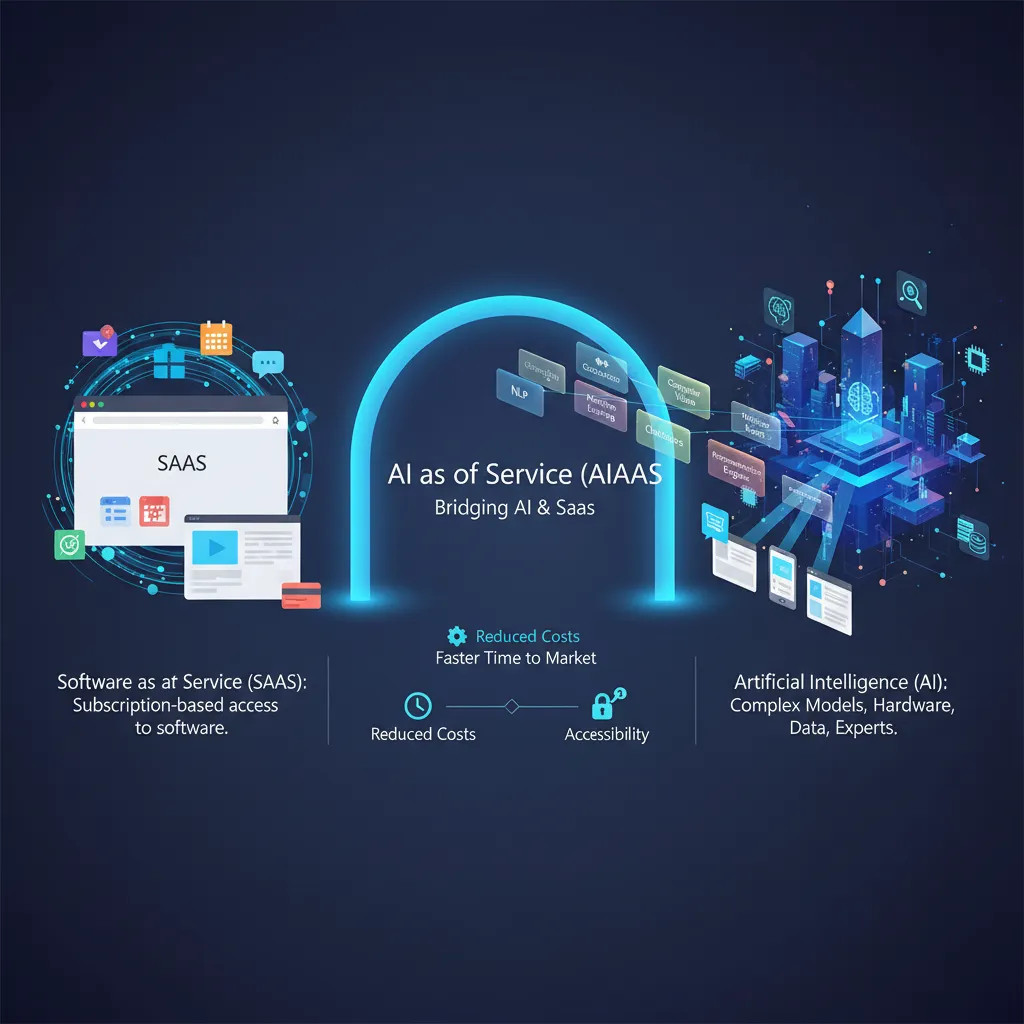
The software industry has always evolved through layers. First came the era of on-premise software, then the internet gave rise to Software as a Service (SaaS), and now artificial intelligence is creating an entirely new delivery model sitting on top of — and increasingly replacing — traditional SaaS. That model is called AAaS: AI as a Service.
If you have been hearing this term alongside discussions about SaaS, cloud computing, and the future of enterprise software, this guide will give you a comprehensive, clear understanding of what AAaS means, how it works, how it differs from traditional SaaS, and why it represents one of the most significant shifts in the software industry in the last two decades.
What Does AAaS Stand For?
AAaS stands for AI as a Service — sometimes also written as AIaaS. It refers to the delivery of artificial intelligence capabilities — including machine learning models, natural language processing, computer vision, predictive analytics, and generative AI — through cloud-based platforms, accessible via APIs or user interfaces, on a subscription or consumption-based pricing model.
In simpler terms, AAaS allows any business or developer to access powerful AI capabilities without needing to build, train, or maintain AI models themselves. Instead of hiring a team of data scientists and investing in expensive GPU infrastructure, a company can subscribe to an AAaS provider and integrate sophisticated AI functionality directly into their products or workflows through a simple API call.
The “as a Service” suffix places AAaS firmly within the broader cloud computing delivery model family that includes Infrastructure as a Service (IaaS), Platform as a Service (PaaS), and Software as a Service (SaaS) — each representing a progressively higher level of abstraction and managed capability.
The Evolution From SaaS to AAaS
To understand what makes AAaS distinct, it helps to trace the evolution of software delivery models and see where AI as a Service fits in the progression.
The SaaS Era
Software as a Service emerged in the late 1990s and early 2000s as the internet made it practical to deliver software applications through a browser rather than requiring installation on individual computers. Salesforce is widely credited as one of the pioneers, proving that enterprise-grade CRM software could be delivered entirely as a cloud-hosted subscription service.
The defining characteristic of SaaS is that it delivers a fixed application — a specific set of features and workflows that all users access in essentially the same way. The software does what it is designed to do, and users configure it within the parameters the software provides. Slack is a messaging tool. HubSpot is a marketing platform. Notion is a productivity workspace. Each does its thing well, within defined boundaries.
The Limitations SaaS Created
As SaaS matured, its limitations became more apparent. Every SaaS product requires ongoing human operation — users must log in, make decisions, configure settings, interpret data, and take action. The software facilitates work but does not perform it autonomously. As businesses accumulated dozens of SaaS subscriptions, the overhead of managing, integrating, and extracting value from all of them grew significantly.
More fundamentally, traditional SaaS applications cannot learn, adapt, or reason. They execute predefined logic. They cannot understand natural language inputs, generate creative outputs, analyze unstructured data, or make probabilistic decisions based on patterns in data. These limitations created the opening for a fundamentally different model.
Enter AAaS
AI as a Service addresses these limitations by delivering software that can understand, reason, generate, and adapt rather than simply executing fixed rules. AAaS platforms expose AI capabilities — often powered by large language models, computer vision systems, or predictive ML models — through APIs and interfaces that any business can plug into their existing stack.
The shift from SaaS to AAaS represents a transition from tools that facilitate human work to systems that perform work autonomously or semi-autonomously. This is why AAaS is increasingly described not just as a new software category but as a fundamental reimagining of what software can do.
How AAaS Works
At a technical level, AI as a Service operates through a straightforward model. An AAaS provider builds, trains, and maintains powerful AI models on large-scale cloud infrastructure — the kind of GPU clusters and distributed computing systems that cost tens or hundreds of millions of dollars to build and operate. They then expose the capabilities of those models through APIs (Application Programming Interfaces) that developers and businesses can call from their own applications.
A developer building a customer service chatbot, for example, does not need to train their own large language model. They can call the API of an AAaS provider like OpenAI, Anthropic, Google, or AWS and send their customer’s message to the model, receiving an intelligent, contextually appropriate response in return. The developer pays for the API calls they make — typically measured in tokens processed — rather than paying for the underlying infrastructure.
This model works at multiple levels of abstraction. At the most basic level, AAaS provides raw model access — the developer sends inputs and receives outputs, and is responsible for building the surrounding application logic. At higher abstraction levels, AAaS providers offer pre-built AI-powered applications — think Jasper for content generation, Midjourney for image creation, or Harvey for legal research — where the AI capabilities are packaged inside a user-friendly interface, much closer to traditional SaaS in appearance but fundamentally different in capability.
Key Categories of AAaS
AI as a Service encompasses a wide range of capability types, each addressing different business needs.
Natural Language Processing (NLP) as a Service
NLP services allow applications to understand, interpret, and generate human language. This includes sentiment analysis, text classification, entity extraction, summarization, translation, and conversational AI. OpenAI’s GPT models, Anthropic’s Claude, and Google’s Gemini are the most prominent examples of NLP-focused AAaS offerings.
Computer Vision as a Service
Computer vision services give applications the ability to analyze and interpret images and video. Use cases include facial recognition, object detection, document processing, quality control in manufacturing, and medical image analysis. AWS Rekognition, Google Vision AI, and Microsoft Azure Computer Vision are leading examples in this category.
Machine Learning as a Service (MLaaS)
MLaaS platforms allow businesses to build, train, and deploy custom machine learning models without managing the underlying infrastructure. Google Vertex AI, Amazon SageMaker, and Microsoft Azure Machine Learning are the dominant platforms in this space. These services sit at the boundary between AAaS and PaaS, providing the tools to create AI capabilities rather than consuming pre-built ones.
Predictive Analytics as a Service
Predictive analytics services use machine learning to forecast outcomes based on historical data. Sales forecasting, demand planning, fraud detection, and churn prediction are common applications. These services are deeply embedded in modern CRM, ERP, and marketing platforms.
Generative AI as a Service
Generative AI represents the newest and fastest-growing category of AAaS. These services can generate text, images, audio, video, and code on demand. OpenAI’s DALL-E and GPT-4o, Stability AI’s image generation models, ElevenLabs’ voice synthesis, and GitHub Copilot’s code generation all fall within this category. Generative AI as a Service is currently experiencing the most rapid adoption and investment of any AAaS segment.
AI Agent as a Service
Emerging as one of the most significant new categories, AI Agent as a Service delivers autonomous AI agents — systems that can plan, reason, take actions, use tools, and complete multi-step tasks without continuous human guidance. Platforms like Relevance AI, AgentOps, and various enterprise offerings from major cloud providers are beginning to deliver agentic AI capabilities as managed services.
AAaS vs. SaaS: Key Differences
Understanding how AAaS differs from traditional SaaS is essential for grasping its significance as a business and technology model.
Output type is the most fundamental difference. SaaS delivers a fixed application with defined features. AAaS delivers dynamic, AI-generated outputs that vary based on inputs, context, and learned patterns. No two outputs from a generative AI system are identical in the way that no two human conversations are identical.
Adaptability separates the two models sharply. Traditional SaaS does what it is programmed to do and nothing more. AAaS systems can adapt their behavior based on new inputs, fine-tuning, and in some cases ongoing learning — making them progressively more useful over time.
Human involvement differs significantly. SaaS requires human operators to drive every significant action. AAaS can operate autonomously across entire workflows, making decisions, generating outputs, and taking actions with minimal or no human intervention.
Pricing models tend to differ as well. SaaS is typically priced on a per-seat, per-month subscription basis. AAaS is often priced on a consumption basis — per API call, per token processed, per image generated — reflecting the variable nature of AI workloads.
Integration depth is also distinct. SaaS products are typically used directly by end users through a dedicated interface. AAaS capabilities are frequently embedded invisibly inside other products and workflows, powering experiences that users may not even recognize as AI-driven.
Major AAaS Providers and Examples
The AAaS landscape is populated by both established technology giants and a rapidly growing ecosystem of specialized startups.
OpenAI is the most prominent pure-play AAaS provider, offering API access to its GPT family of language models, DALL-E image generation, Whisper speech recognition, and the emerging operator and agent frameworks that enable agentic AI applications.
Anthropic provides API access to its Claude family of models, positioning them for enterprise use cases that require high reliability, safety, and long context window capabilities. Claude is used by a wide range of businesses to power customer-facing AI features, internal knowledge tools, and automated workflows.
Google Cloud offers an extensive AAaS portfolio through Vertex AI, including access to Gemini models, pre-trained vision and NLP APIs, AutoML for custom model training, and a growing suite of generative AI development tools.
Amazon Web Services delivers AI capabilities through Bedrock — a managed service providing access to foundation models from multiple providers — alongside specialized services like Rekognition, Comprehend, Textract, and Forecast.
Microsoft Azure integrates AAaS capabilities throughout its cloud platform, with Azure OpenAI Service providing enterprise-grade access to OpenAI models, alongside Azure Cognitive Services and the deeply AI-integrated Microsoft 365 Copilot suite.
Specialized providers like Cohere for enterprise NLP, ElevenLabs for voice synthesis, Runway for video generation, and Hugging Face for open-source model deployment represent the growing ecosystem of focused AAaS platforms targeting specific capability domains.
Benefits of AAaS for Businesses
The AAaS model delivers a set of advantages that explain its rapid adoption across virtually every industry sector.
Accessibility is the most transformative benefit. AAaS democratizes access to AI capabilities that would otherwise require massive investment in talent, infrastructure, and research. A startup with five employees can access the same underlying language model capabilities as a Fortune 500 enterprise, leveling the competitive playing field in ways that were not previously possible.
Speed to market is dramatically accelerated. Building AI capabilities from scratch — collecting training data, designing model architectures, training, evaluating, and deploying — can take years. AAaS reduces this timeline to days or weeks, allowing businesses to integrate sophisticated AI features into their products at a pace that matches modern competitive environments.
Cost efficiency benefits most businesses, particularly at early stages. Rather than investing millions in AI infrastructure and research teams upfront, businesses pay for what they use, scaling costs proportionally with their actual consumption and revenue.
Ongoing improvement is built into the AAaS model. When a provider improves their underlying models, all customers accessing those models through the API benefit automatically, without any action required on their part. This creates a continuous improvement cycle that traditional software cannot match.
Focus on core business is an often-overlooked benefit. When AI infrastructure is managed by a specialist provider, businesses can focus their engineering and product resources on the unique value they create rather than on the generic infrastructure of AI model management.
Challenges and Considerations of AAaS
No technology model is without its challenges, and AAaS introduces a set of considerations that businesses must navigate thoughtfully.
Data privacy and security are the most pressing concerns for enterprise adopters. Sending sensitive business data to third-party AI APIs raises legitimate questions about data handling, storage, training data usage, and regulatory compliance — particularly for businesses operating in regulated industries like healthcare, finance, and legal services. Most major AAaS providers now offer enterprise agreements with strong data privacy protections and options to opt out of training data usage.
Vendor dependency — sometimes called vendor lock-in — is a structural risk of AAaS adoption. If a business builds deeply integrated workflows around a specific AAaS provider’s API and that provider changes pricing, deprecates models, or experiences service disruptions, the impact can be significant. Designing for portability and maintaining the ability to switch providers is an important architectural consideration.
Cost unpredictability can become a challenge at scale. Consumption-based pricing is efficient at low volumes but can become difficult to forecast and control as usage grows. Unexpected spikes in AI API usage can translate directly into unexpected cost spikes.
Output reliability remains an inherent characteristic of generative AI systems that businesses must plan for. AI-generated outputs are probabilistic rather than deterministic — meaning the same input can produce different outputs across different calls, and outputs can contain errors, hallucinations, or inconsistencies that require human review in high-stakes contexts.
The Future of AAaS: Where It Is Heading
Several clear trends are shaping the trajectory of AI as a Service over the next several years.
Agentic AI is the most significant near-term development. As AI agents — systems that can plan, use tools, browse the web, write and execute code, and complete complex multi-step tasks — become more capable and reliable, AAaS platforms will increasingly deliver autonomous agents as their core product rather than passive API endpoints.
Vertical specialization is accelerating as the market matures. Rather than general-purpose AI APIs, a growing wave of AAaS providers are building deeply specialized AI services for specific industries — legal AI, medical AI, financial AI, construction AI — trained on domain-specific data and optimized for the particular workflows and compliance requirements of those industries.
On-device and edge AI is emerging as a complement to cloud-based AAaS. As AI models become smaller and more efficient, it is increasingly practical to run capable AI models directly on user devices — phones, laptops, and edge computing systems — without sending data to the cloud. This hybrid model of cloud AAaS for complex tasks and on-device AI for latency-sensitive or privacy-critical applications will define much of the next phase of AI deployment.
Commoditization of base models is already underway. As multiple providers offer increasingly capable foundation models at competitive prices, the differentiation in AAaS will shift progressively from model capability to reliability, customization, integration quality, industry specialization, and the quality of the surrounding developer and enterprise experience.
Frequently Asked Questions
What is the difference between SaaS and AAaS? SaaS delivers fixed software applications that users operate through a defined interface. AAaS delivers AI capabilities — including language understanding, generation, prediction, and autonomous action — that can be integrated into products and workflows. SaaS facilitates human work; AAaS can increasingly perform work autonomously.
Is AAaS the same as MLaaS? Machine Learning as a Service (MLaaS) is a subset of the broader AAaS category. MLaaS specifically refers to platforms that allow businesses to build, train, and deploy custom machine learning models. AAaS is broader, encompassing pre-built AI capabilities accessed via API as well as generative AI, computer vision, NLP, and AI agent services.
Which companies are the biggest AAaS providers? The largest AAaS providers include OpenAI, Anthropic, Google Cloud (Vertex AI), Amazon Web Services (Bedrock), and Microsoft Azure (Azure OpenAI Service). A large and growing ecosystem of specialized providers — Cohere, ElevenLabs, Runway, Stability AI, and many others — serve specific capability domains.
Is AAaS suitable for small businesses? Yes. The AAaS model is particularly well-suited to small and medium businesses because it provides access to enterprise-grade AI capabilities on a consumption basis, without requiring large upfront investment in infrastructure or AI talent. Many AAaS providers offer free tiers or low-cost entry points that make experimentation accessible to businesses of any size.
What are the main risks of adopting AAaS? The primary risks include data privacy and security concerns when sending sensitive data to third-party APIs, vendor dependency if workflows become deeply integrated with a single provider, cost unpredictability at scale with consumption-based pricing, and output reliability challenges inherent in generative AI systems that require human oversight in high-stakes applications.
How is generative AI changing the AAaS landscape? Generative AI has dramatically accelerated AAaS adoption by making AI capabilities tangible and accessible to non-technical users for the first time. The ability to generate text, images, code, and other content on demand has opened entirely new product categories and business models, and it has shifted the competitive dynamics of the SaaS industry significantly as AI-native products begin to challenge established software incumbents.
Conclusion
AAaS — AI as a Service — represents one of the most consequential shifts in the history of software. By making sophisticated AI capabilities accessible through APIs and cloud platforms on a consumption basis, it is democratizing access to technology that was previously available only to the largest and most technically sophisticated organizations in the world.
For businesses built on traditional SaaS models, AAaS represents both a competitive threat and an extraordinary opportunity. The threat comes from AI-native competitors that can deliver superior outcomes with fewer human touchpoints. The opportunity comes from integrating AAaS capabilities into existing products and workflows to dramatically improve what those products can do for their users.
Understanding what AAaS is, how it works, and where it is heading is no longer optional for anyone working in technology, marketing, product management, or business strategy. It is foundational knowledge for navigating the most significant technological transition of the current decade.