
Looking for a strands hint to solve today’s New York Times word puzzle? You’re not alone. The NYT Strands game has quickly become one of the most addictive word puzzles since its beta launch, challenging players to find hidden theme words and the elusive spangram that connects opposite sides of the game board. Whether you’re stuck on a particularly tricky puzzle or want to improve your solving strategies, this comprehensive guide provides everything you need to master Strands and never miss a daily challenge again.
The Strands puzzle game combines elements of traditional word searches with innovative gameplay mechanics that require strategic thinking and pattern recognition. Unlike simple word games, Strands demands that you identify thematic connections between words while navigating a grid of seemingly random letters. With daily puzzles resetting at midnight, millions of players worldwide race to solve these brain-teasers, often seeking hints and strategies to maintain their winning streaks.
This guide covers proven solving techniques, common strands hint patterns, spangram identification methods, and expert tips from top players who consistently solve puzzles in record time. You’ll learn how to recognize theme patterns, develop efficient letter-scanning techniques, and use strategic hints without spoiling the satisfaction of solving puzzles independently.
What Is NYT Strands Game? Understanding the Basics
NYT Strands is a word puzzle game developed by The New York Times Games division, joining popular titles like Wordle, Connections, and the classic Crossword. Launched in beta testing, Strands quickly gained a dedicated following among word game enthusiasts who appreciate its unique blend of word search mechanics and thematic reasoning.
The game presents players with a 6×8 grid containing 48 letters. Your objective is to find all theme words hidden within this grid by connecting adjacent letters in any direction—horizontally, vertically, or diagonally. What makes Strands particularly challenging is that letters can only be used once per word, and you must identify the puzzle’s central theme to find all required words.
Core Game Elements:
Theme Words: Each puzzle contains 5-7 theme-related words that players must discover. These words connect to a central concept revealed through the puzzle’s title or clue.
Spangram: This special word uses letters that span from one side of the board to the opposite side, typically revealing or reinforcing the puzzle’s theme. Finding the spangram often unlocks understanding of the entire puzzle.
Hint System: The game includes a built-in hint mechanism that reveals theme words when you find three non-theme words of at least four letters each. This system helps stuck players without completely spoiling the puzzle.
Daily Format: Like other NYT games, Strands releases one new puzzle daily at midnight Eastern Time, creating a shared experience among players worldwide.
The difficulty level varies significantly between puzzles, with some themes being immediately obvious while others require deep vocabulary knowledge or lateral thinking to solve completely.
How to Play Strands: Step-by-Step Game Rules
Understanding the fundamental rules and mechanics is essential before diving into advanced strands hint strategies. Here’s a comprehensive breakdown of how the game works:
Starting the Puzzle
When you open a new Strands puzzle, you’ll see a title or thematic clue at the top and the 6×8 letter grid below. Read the theme carefully, as it provides crucial context for identifying valid words. Some themes are straightforward category names, while others use wordplay or require interpretation.
Creating Words
To form words, tap or click on letters in the grid, connecting them in any direction. Letters must be adjacent to each other, and you can change direction mid-word. Valid words highlight in blue as you select them, while invalid selections show in gray. Once you submit a word, those letters temporarily change color to indicate they’ve been used.
Theme Words vs. Non-Theme Words
When you find a theme word that matches the puzzle’s concept, it becomes highlighted permanently and moves to the solved words list. Non-theme words of four letters or more contribute toward earning hints but don’t count toward puzzle completion. Three non-theme words unlock one hint that reveals a theme word location.
Finding the Spangram
The spangram is the puzzle’s keystone—a theme word that touches opposite edges of the board. It often encapsulates the entire theme in one word and typically becomes easier to spot once you’ve identified several theme words. The spangram uses more letters than regular theme words and follows a path that traverses the board’s width or height.
Winning the Puzzle
You complete the puzzle when you’ve found all theme words and the spangram. The game displays a completion message and tracks your solving streak. Many players compete for solving speed, though Strands doesn’t include an official timer like Wordle.
Strands Hint Strategies: Proven Techniques to Solve Faster
Developing effective solving strategies transforms how quickly you can complete daily Strands puzzles. Expert players employ several proven techniques that beginners can learn and practice:
Theme Analysis First
Before touching the letter grid, spend 30-60 seconds analyzing the puzzle’s theme clue. Ask yourself: Is this a category (types of trees, musical instruments)? Does it involve wordplay or puns? Are there multiple interpretations? Understanding theme nuances helps you recognize valid words faster and avoid wasting time on irrelevant letter combinations.
Scan for High-Value Letters
Certain letters appear less frequently but often signal theme words. Look for Q, Z, X, J, and K first, as words containing these letters are typically easier to spot in dense grids. Similarly, common letter combinations like TH, CH, SH, ING, and ED can anchor your search for longer words.
Spangram Priority Strategy
Some experienced players hunt for the spangram immediately, as finding it often reveals the theme’s exact nature and makes other words easier to identify. Look for longer letter paths that traverse the board from edge to edge, especially those containing theme-relevant letters.
Perimeter Scanning
Start your search along the grid’s edges, where words have fewer possible letter connections. This systematic approach ensures you don’t overlook edge-located theme words while providing a structured way to examine the entire board.
Build from Found Words
Once you identify one theme word, look for related words nearby. Puzzle creators often cluster thematically related words in the same grid region, making this strategy particularly effective for category-based themes.
Use the Hint System Wisely
Don’t hesitate to find non-theme words to unlock hints when genuinely stuck. Three four-letter words can be found quickly in most grids, and revealing one theme word often creates breakthrough moments that help you solve remaining words independently.
Pattern Recognition Development
Regular Strands players develop an intuitive sense for how words arrange themselves in grids. Common patterns include diagonal descents, zigzag paths, and circular letter arrangements. Training your brain to recognize these patterns accelerates solving speed significantly.
Reverse Engineering
If you know the theme but can’t find specific words, think about what vocabulary likely appears in the puzzle. For a “kitchen appliances” theme, mentally list obvious choices (refrigerator, microwave, blender) and then scan specifically for those letter sequences.
Common Strands Hint Patterns and Theme Categories
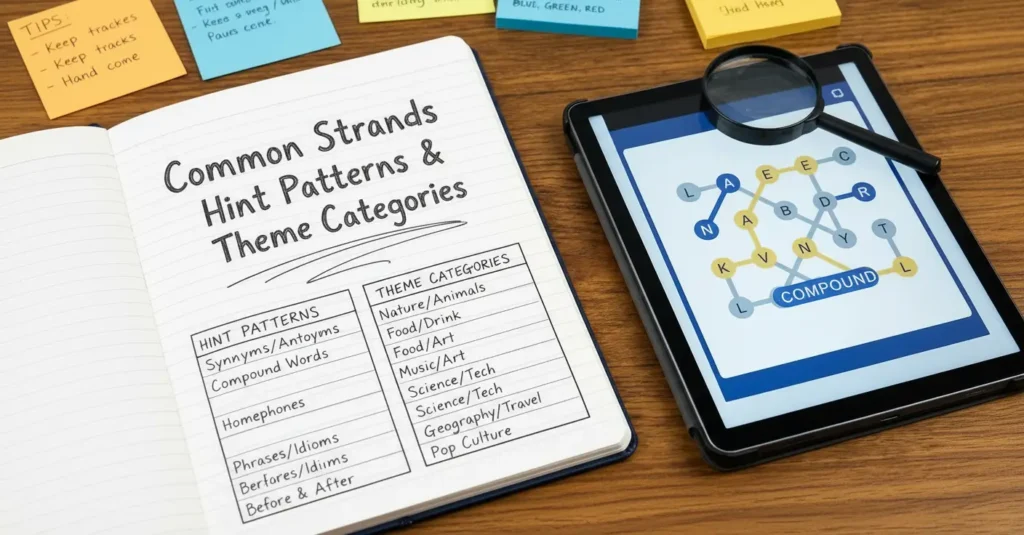
Understanding recurring theme patterns helps you anticipate puzzle structures and identify words faster. NYT Strands creators use several popular theme categories:
Category-Based Themes
These straightforward themes ask you to find words within a specific category. Examples include types of birds, programming languages, desserts, countries, or emotions. The theme clue clearly indicates the category, making word identification primarily a vocabulary challenge.
Wordplay and Puns
More challenging puzzles employ wordplay where the theme clue has multiple meanings or requires lateral thinking. A theme like “Things that are green” might include both colors and environmental concepts, or “Keys” could reference both door keys and piano keys.
Compound Word Themes
Some themes involve words that combine with a common element. For instance, all theme words might end with the same suffix or begin with the same prefix. Recognizing this pattern early dramatically simplifies word finding.
Related Concepts
These themes connect words through abstract relationships rather than direct categories. Words might all relate to a specific movie, share historical connections, or represent different aspects of a single concept.
Phrases and Expressions
Occasional themes include common phrases or idioms where you find individual words from multi-word expressions. These require recognizing how standalone words contribute to larger linguistic units.
Seasonal and Event-Based Themes
NYT often creates themed puzzles around holidays, current events, or seasonal topics, making them timely and culturally relevant but potentially more challenging for international players unfamiliar with specific references.
Pattern Recognition Tips:
Look for plurals vs. singular forms based on theme structure. Count-based themes often use consistent grammatical forms. When you find one theme word, consider whether others likely share similar letter counts, parts of speech, or structural features. Theme consistency often provides subtle hints about remaining words.
How to Find the Spangram: Advanced Location Techniques
The spangram represents Strands’ unique challenge—a theme word that must touch opposite board edges. Mastering spangram identification significantly improves solving efficiency:
Edge-to-Edge Scanning
Systematically trace potential paths from left to right, top to bottom, and diagonally corner to corner. The spangram must begin at one edge and end at the opposite, creating natural starting and ending points for your search.
Length Estimation
Spangrams typically use 8-15 letters because they traverse the entire board. Focus on longer letter sequences that create continuous paths across multiple grid rows or columns. Short words rarely serve as spangrams due to geometric constraints.
Theme Encapsulation
The spangram often literally describes the theme or represents its broadest interpretation. For a “musical instruments” theme, the spangram might be “percussion” or “orchestra” rather than specific instrument names. Think about umbrella terms or theme-summarizing words.
Color Coding Strategy
As you find theme words, their letters become unavailable. Watch which edge letters remain unused—the spangram must pass through available edge letters, narrowing your search area as the puzzle progresses.
Common Spangram Patterns
Experienced players notice that spangrams frequently follow diagonal paths or create gentle curves rather than zigzagging wildly. This tendency reflects puzzle design principles that create aesthetically pleasing letter arrangements.
Reverse Logic
If you’ve found all theme words except the spangram, the remaining available letters must form it. Use process of elimination to identify which letter combinations could create edge-to-edge paths with the unused letters.
Letter Distribution Analysis
Spangrams rarely waste letters. If you notice an unusual letter like Q or Z near one edge and appropriate completing letters near the opposite edge (like UESTION or EBRA), investigate that potential path first.
Today’s Strands Hint and Answer Solutions
While this guide focuses on teaching solving strategies rather than simply providing answers, understanding how to effectively use daily strands hint resources helps maintain your solving streak without completely spoiling puzzles:
Progressive Hint Systems
The best strands hint resources provide graduated assistance levels. Start with theme clarification hints that explain the puzzle’s concept without revealing specific words. Progress to partial word hints showing word lengths or first letters. Only resort to full answer reveals when completely stuck and running out of time.
Official Hint Mechanism
NYT Strands’ built-in hint system requires finding three non-theme words of at least four letters. This elegant solution provides help without cheapening the solving experience. When you earn a hint, the game highlights one theme word’s letter locations, often choosing easier words to give you momentum.
Community Hint Resources
Dedicated Strands communities share daily hints at various spoiler levels. These resources typically post morning hints for early solvers and complete solutions later in the day for those seeking answers. Popular gaming forums, Reddit communities, and specialized websites maintain daily threads where players discuss strategies and share hints.
Hint Usage Strategy
Consider hints as learning opportunities rather than failures. After using a hint to discover a theme word you couldn’t find, analyze why you missed it. Was it obscure vocabulary? Did you not recognize the theme pattern? Using this reflective approach improves your independent solving ability over time.
Spoiler-Free Resources
Some players prefer spoiler-free hint communities where participants discuss strategies and share theme interpretations without revealing specific words. These discussions often provide sufficient context to solve puzzles independently while maintaining the challenge.
Answer Archive Value
Past puzzle solutions serve as excellent learning tools. Reviewing previous themes and spangrams reveals pattern trends and expands your vocabulary for future puzzles. Many dedicated players maintain personal archives noting particularly clever themes or challenging word arrangements.
Strands Solver Tools and Helper Applications
Various digital tools assist Strands players, though their use sparks debate within the community regarding puzzle-solving purity:
Letter Arrangement Analyzers
These tools accept the 6×8 letter grid and identify all possible words, highlighting theme word candidates based on common categories. While powerful, they eliminate much of the puzzle’s intellectual challenge and satisfaction.
Word Finder Databases
When you’ve identified the theme but can’t think of relevant vocabulary, word finder tools let you search by category or pattern. For instance, searching “six-letter birds” might reveal theme words you know but didn’t recall under pressure.
Anagram Solvers
Less useful for Strands than other word games, anagram solvers can occasionally help identify difficult theme words when you’ve isolated available letters but can’t arrange them mentally.
Pattern Recognition Software
Advanced tools use AI to analyze letter grids and suggest probable spangram paths based on common arrangement patterns. These represent the most sophisticated Strands assistance but also the most controversial.
Community-Sourced Hints
Social platforms where players share real-time hints and strategies offer assistance while maintaining community engagement. These interactive resources feel less like cheating than automated solvers because they preserve the social puzzle-solving aspect.
Mobile Apps
Several unofficial mobile applications provide daily Strands hints, answer archives, and solving statistics tracking. These apps integrate hint systems with achievement tracking to gamify the learning process.
Ethical Considerations
The Strands community generally accepts hint usage for learning and maintaining streaks but views automated solvers as contrary to the puzzle’s spirit. Most players advocate using hints progressively—starting with theme clarifications and only advancing to direct answers when genuinely necessary for streak preservation or time constraints.
Expert Tips for Improving Your Strands Solving Skills
Becoming proficient at Strands requires developing specific cognitive skills and knowledge bases:
Vocabulary Expansion
The single most impactful improvement strategy involves broadening your vocabulary, especially in common theme categories. Read diversely, maintain word lists for puzzle categories, and study etymology to understand word relationships better.
Visual Pattern Training
Practice identifying letter patterns in word search puzzles and similar games. This trains your brain to recognize valid letter paths quickly, reducing the time spent manually tracing each potential word.
Theme Recognition Practice
Review past Strands themes to identify common patterns and categories. Understanding creator preferences and recurring theme structures helps you anticipate future puzzle directions.
Speed Reading Techniques
Developing faster visual processing of letter grids accelerates word identification. Practice scanning techniques used in speed reading to improve how quickly you can evaluate letter combinations.
Consistent Daily Practice
Like any skill, regular practice yields improvement. Maintaining a daily Strands solving habit develops pattern recognition abilities and expands your mental database of possible theme categories.
Learn from Mistakes
When you miss theme words that seem obvious in retrospect, analyze why. Did you not know the vocabulary? Did you misunderstand the theme? Was the letter path non-intuitive? Each mistake offers learning opportunities.
Community Engagement
Join Strands communities to learn how other players approach puzzles. Different solving strategies suit different cognitive styles, and exposure to varied approaches helps you develop your own optimized method.
Cross-Game Skills
Playing other NYT games like Connections, Wordle, and the Mini Crossword develops complementary skills. Connections improves category recognition, Wordle enhances letter pattern awareness, and crosswords expand vocabulary.
Mental Flexibility
Train yourself to consider multiple theme interpretations simultaneously. The ability to pivot between different thematic understandings when initial assumptions prove incorrect separates expert solvers from beginners.
Time Management
While Strands doesn’t include timers, setting personal time goals encourages focused solving and prevents overthinking. Many players aim to complete puzzles in under 5-10 minutes as skill improves.
Strands Game History and Development Background
Understanding Strands’ development context enriches appreciation for its design and helps predict future directions:
NYT Games Evolution
The New York Times has transformed from primarily a crossword publisher to a comprehensive digital gaming platform. Following Wordle’s acquisition success in 2022, NYT Games invested heavily in developing and acquiring word puzzles that appeal to diverse solver demographics.
Beta Testing Phase
Strands launched in beta testing to gather player feedback before full release. This approach allows developers to refine difficulty balancing, hint systems, and theme selection based on actual player behavior and preferences.
Design Philosophy
Strands creators aimed to innovate beyond traditional word searches by adding thematic reasoning requirements and the spangram mechanic. This design philosophy prioritizes intellectual challenge over simple vocabulary testing.
Community Growth
The game rapidly developed an engaged community of daily solvers who share strategies, create hint resources, and compete informally through solving streak comparisons. This community aspect mirrors successful puzzle game models like Wordle’s social sharing features.
Future Development
Based on beta feedback, developers continue refining theme difficulty progression, hint system effectiveness, and accessibility features. Potential future additions might include difficulty level options, expanded hint systems, or competitive multiplayer modes.
Cultural Impact
Strands represents the ongoing evolution of word puzzle games in the digital age, combining traditional word game elements with modern game design principles and social engagement mechanisms.
Common Strands Mistakes and How to Avoid Them
Recognizing frequent solving errors helps you avoid them and improve performance:
Overthinking Simple Themes
Many players assume themes must be complex, overlooking straightforward category interpretations. When stuck, consider the most literal theme interpretation before seeking elaborate wordplay.
Ignoring Non-Theme Words
Some solvers refuse to find non-theme words, viewing them as failures. However, strategically finding three four-letter words to unlock hints often proves more efficient than struggling indefinitely on difficult theme words.
Letter Reuse Attempts
Remember that each letter can only be used once per word. Players frequently try to reuse letters, creating invalid word attempts that waste time and cause frustration.
Spangram Neglect
Focusing exclusively on theme words while ignoring the spangram often leads to getting stuck with one remaining word. Alternating between theme word and spangram searches maintains solving momentum.
Theme Fixation
Becoming convinced of an incorrect theme interpretation causes players to search for irrelevant words while overlooking actual theme words. Remain flexible and willing to reconsider theme understanding when words don’t materialize.
Path Complexity Assumptions
Players sometimes assume valid words must follow simple, straight paths. Strands frequently uses zigzagging, circular, or spiral letter arrangements, so exploring complex paths often reveals hidden words.
Vocabulary Limitations
Refusing to expand vocabulary knowledge caps solving ability. When encountering unfamiliar theme words, treat them as learning opportunities rather than puzzle failures.
Hint Resistance
Some players view any hint usage as cheating, preferring to abandon puzzles rather than use help. This approach unnecessarily limits enjoyment and learning. Using progressive hints maintains challenge while preventing complete frustration.
Strands Mobile App and Platform Availability
Access and platform options affect how players engage with Strands:
Web Browser Access
The primary way to play Strands is through the NYT Games website, accessible via any modern web browser on desktop or mobile devices. This approach requires no downloads and works across platforms seamlessly.
Mobile Browser Experience
NYT optimized the mobile browser experience for touch interfaces, making letter selection and word formation intuitive on smartphones and tablets. The responsive design adapts to various screen sizes effectively.
NYT Games App Integration
While Strands may integrate into the comprehensive NYT Games mobile application, currently it remains primarily accessible through web browsers. The NYT Games app houses Wordle, Connections, and other puzzles, suggesting eventual Strands inclusion.
Offline Play Limitations
Unlike some puzzle games, Strands requires internet connectivity to load daily puzzles and sync solving progress. This online-only approach prevents playing during internet outages but enables leaderboard features and puzzle security.
Cross-Platform Progress
NYT account integration allows progress tracking across devices. Starting a puzzle on your phone and finishing on desktop works seamlessly, maintaining solved words and hint usage.
Accessibility Features
The platform includes various accessibility options like adjustable text sizes, color contrast modes, and keyboard navigation support, making Strands playable for users with different needs.
Future App Development
Given NYT’s pattern of developing dedicated apps for successful puzzle games, a standalone Strands mobile application may launch after beta testing concludes, offering enhanced features like offline puzzle caching and advanced statistics tracking.
Strands vs. Other NYT Word Games: Key Differences
Comparing Strands to similar NYT puzzle offerings helps players understand its unique characteristics:
Strands vs. Wordle
While both are daily word games, Wordle focuses on deductive reasoning to identify a single five-letter word, while Strands requires finding multiple thematically connected words within a letter grid. Wordle emphasizes logical deduction, Strands emphasizes vocabulary breadth and visual pattern recognition.
Strands vs. Connections
Connections asks players to group 16 words into four themed categories without using a letter grid. Strands provides the letters but requires identifying both the theme and forming words from available letters. Connections is purely categorical reasoning, while Strands combines category recognition with word formation.
Strands vs. Spelling Bee
Spelling Bee provides seven letters and challenges players to form as many words as possible using a mandatory center letter. Strands uses a larger letter set, requires finding specific theme words, and includes the spangram mechanic. Spelling Bee allows unlimited word finding, while Strands has a defined completion state.
Strands vs. Traditional Word Search
Standard word searches provide a word list to find within a grid. Strands reveals only the theme, requiring players to deduce which words to search for. This fundamental difference transforms word search from a visual scanning exercise into a reasoning challenge.
Strands vs. Crossword
NYT Crosswords rely on clue-solving and letter intersection logic, while Strands uses theme interpretation and letter grid navigation. Crosswords are typically longer activities requiring diverse knowledge, while Strands offers quicker solving experiences focused on vocabulary within specific themes.
Unique Strands Features
The spangram mechanic is Strands’ signature innovation, creating a meta-puzzle within the puzzle. This edge-to-edge word requirement adds strategic depth absent from similar games. Combined with the progressive hint system and thematic reasoning requirement, Strands occupies a distinct niche in the NYT Games portfolio.
Building Your Strands Solving Streak: Consistency Tips
Maintaining long solving streaks requires both skill and strategic approaches:
Daily Routine Integration
Incorporate Strands into your morning routine, lunch break, or evening wind-down. Consistent timing creates habits that reduce the likelihood of forgetting daily puzzles.
Difficulty Awareness
Recognize that some puzzles are genuinely harder than others. Don’t let challenging days discourage you—use hints strategically to maintain your streak during difficult puzzles.
Time Budget Setting
Allocate a specific time limit for daily Strands solving. If you haven’t completed the puzzle within your budget, use hints rather than abandoning the puzzle and breaking your streak.
Hint Strategy for Streaks
Develop a personal hint policy that maintains challenge while protecting streaks. Many players use one hint per puzzle maximum, only resorting to answers when facing puzzle-ending difficulty.
Community Support
Join Strands communities where players support each other’s streaks through spoiler-controlled hints and encouragement. Knowing others face similar challenges reduces pressure and provides motivation.
Backup Reminders
Set phone reminders or calendar alerts for your preferred solving time to prevent forgetting daily puzzles, especially during busy periods or when traveling.
Recovery Mindset
If you break a streak, immediately start a new one rather than losing motivation. Long-term Strands enjoyment matters more than any individual streak number.
Skill Development Focus
View streak maintenance as a skill-building journey rather than just a number to preserve. Each puzzle completed, whether with or without hints, contributes to improving your solving abilities.
Frequently Asked Questions About Strands Hints
How do I get hints in NYT Strands?
Find three non-theme words of at least four letters each to unlock one hint. The hint highlights one theme word’s location on the board. You can earn multiple hints per puzzle by finding additional sets of three non-theme words.
What is a spangram in Strands?
A spangram is a special theme word that touches two opposite edges of the game board. Every Strands puzzle contains exactly one spangram, which often encapsulates or clarifies the puzzle’s overall theme.
When do new Strands puzzles release?
New Strands puzzles release daily at midnight Eastern Time, similar to other NYT puzzle games. The puzzle remains available for 24 hours before the next day’s puzzle replaces it.
Can I play old Strands puzzles?
Currently, Strands only offers the daily puzzle without an archive of previous puzzles. However, third-party websites maintain archives of past puzzles and answers for practice and review.
Are there different difficulty levels in Strands?
Strands doesn’t offer selectable difficulty levels. Each daily puzzle has its own inherent difficulty based on theme obscurity, vocabulary requirements, and letter arrangement complexity, creating natural variation in solving challenge.
How long does it take to solve a Strands puzzle?
Average solving times vary widely based on skill level and puzzle difficulty. Beginners might take 10-20 minutes, while experienced players often complete puzzles in 3-7 minutes. Some particularly challenging puzzles may take longer even for experts.
Can I play Strands without an NYT subscription?
During beta testing, Strands is available free to all users. However, NYT may eventually require a Games subscription for access, following the model used for Spelling Bee and other premium puzzle content.
What happens if I can’t find all the words?
You can use the hint system to reveal theme words when stuck. If you prefer not to use hints, you can simply move on to the next day’s puzzle. There’s no penalty for incomplete puzzles beyond not receiving completion credit.
How many theme words are in each Strands puzzle?
Strands puzzles typically contain 5-7 theme words plus one spangram, though the exact number varies based on puzzle design. The game indicates total word count, helping you track solving progress.
Can letters be used multiple times in Strands?
No, each letter in the grid can only be used once per word. However, the same letter can appear in multiple different words, as long as each word uses a different instance of that letter from different grid positions.
Conclusion
Mastering Strands requires balancing multiple skills: vocabulary knowledge, visual pattern recognition, thematic reasoning, and strategic hint usage. Whether you’re seeking today’s strands hint to maintain your solving streak or developing long-term strategies to solve puzzles independently, the techniques covered in this guide provide a comprehensive foundation for improvement.
The game’s unique combination of word search mechanics, thematic challenges, and the innovative spangram concept creates a daily puzzle experience that remains fresh and engaging. As you continue your Strands journey, remember that using hints strategically serves as a learning tool rather than a shortcut, helping you recognize patterns and expand vocabulary for future puzzles.
For more NYT puzzle game strategies and daily gaming tips, explore comprehensive guides to Wordle solving techniques, Connections category strategies, and Spelling Bee scoring methods. The thriving community of puzzle enthusiasts at NYT Games Forum offers additional support and discussion for daily challenge solvers.